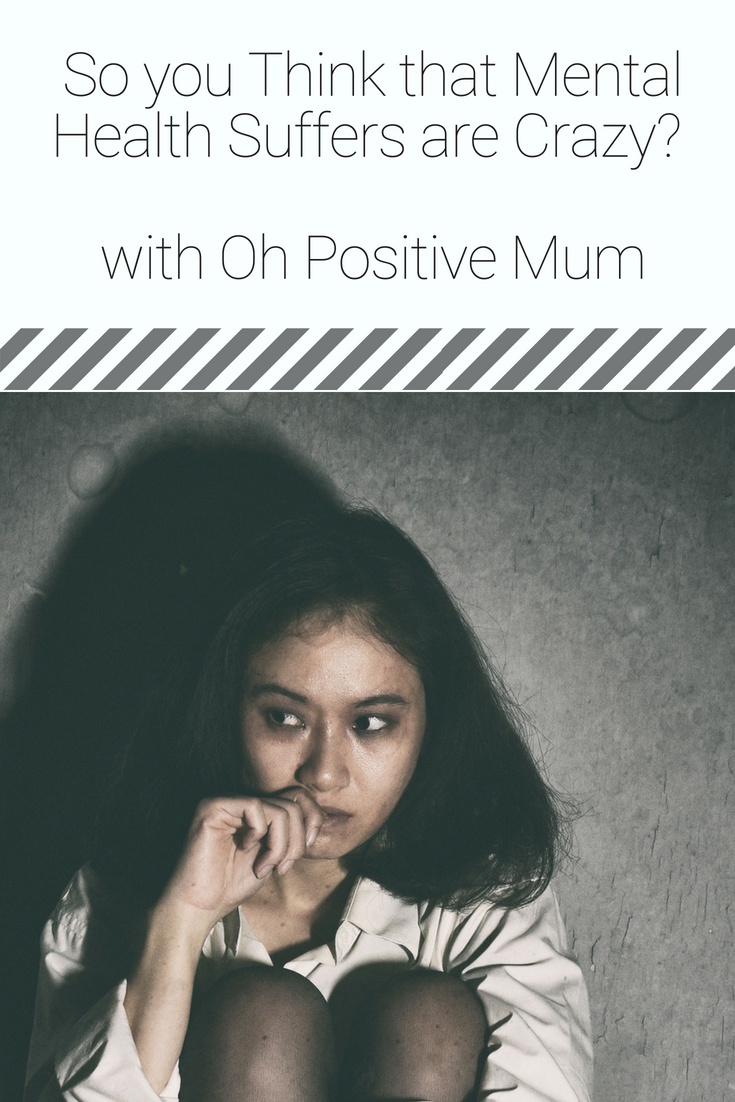
So you Think that Mental Health Suffers are Crazy? with Oh Positive Mum
Today I have a post from Danielle of Oh Positive Mum. If you asked me some of the names of people who I have known on the net for the longest Danielle would come up as one of them, having first gotten to know her in my teens we drifted apart throughout our twenties and have recently reconnected. I was unsurprised to find out she also blogged, after all, she made my first LiveJournal theme many years ago.
Anyway, I shall stop rambling and hand you over to Danielle and her post:
Do you know what it is to suffer from mental health issues?
Truth is no one today knows the full amount of illnesses that contribute to mental health. Thankfully with every passing day, there is more research into what affects us. New discoveries and help for those that suffer from the issue make it easier to talk about it.
We had come a long way from the Victorian age when a woman was locked up in asylums for enjoying a good novel and not acting as a dutiful wife.
This was even noted to be the rational thing to do. And such ideas took their time to move on from that way of thinking, and those ideas and practices continued into the 1970’s.
Women who did not behave ‘properly’ risked ending up in psychiatric care. Many feminist writers also criticised psychoanalysis, the then-dominant approach in psychiatry. They argued Freud’s focus on sexual fantasies, and the fact that most of his patients were women, rehashed old ideas. It was similar to hysteria being labelled a ‘women’s problem’ that should be cured by finding a man.
Moving forward
Today having a mental health issue is talked about. Celebrities such as Ruby Wax even published a book on their take on it.
We have learnt that many well-known people have ended their life because of it, such as Robin Williams. And yet the topic is still not an easy one to bring up in general.

Why is it difficult to talk about?
If like me you find yourself sitting with a cuppa watching the television on an evening, you might have seen the Lloyds Bank advert. The one where that have different people trying to guess what is on the post-it note stuck to their head.
The idea behind the advert is to say that they are a bank that understands their customers. But for me watching it, it made me realise that mental health isn’t just the typical, depression, anxiety or even Schizophrenia. The range of what comes under psychological health is enormous!
Here is something else for you to think about. One in four people will suffer from mental health issues at some point in their lifetime.
We really need to talk more
Twenty-five per cent of us will suffer from mental health issue at some point in our life. We not only need to talk about it more but come to grips with what it means and how to respond to someone going through it.

Let me call it something else for a moment.
If I was writing a post about Cancer, and that is fifty per cent of people will get in their lifetime.
I’m going to guess that you’ll spend the next few articles reading up on ways on how not to get; how to improve your lifestyle; how to recognise the signs of; and so on.
What makes mental health any different?
Mental illness is common. It affects thousands of people in the UK, and their friends, families, work colleagues and society in general.
- One in four people will experience a mental health problem at some point in their lives.
- Around one in ten children experience mental health problems.
- Depression affects around one in 12 of the whole population.
- Rates of self-harm in the UK are the highest in Europe at 400 per 100,000.
- 450 million people worldwide have a mental health problem.
Most people who experience mental health problems recover fully or are able to live with and manage them, especially if they get help early on.
In the last year, a good friend of mine got walloped with terrible results. Thankfully having gone through something similar, I saw it and could relate and managed to encourage her to get medical help.
As she talked to me, telling me how it feels and even though she knew that most of it was not correct. It was real; she thought it; felt it; it was crushing her from the inside. I described to her how I felt going through depression, and how it made me feel like happiness was this made up word, that you had to pretend for everyone else.
That a dark cloud just followed you, no matter where you went. It sucked all the colour from the world around you, and the only reason you were still here, was your body continued to breathe and your heartbeat.
My friend was suffering from anxiety. We aren’t talking about just worrying about things. She continually felt dread of, well of everything.To the point, she just couldn’t move. Constant headaches that blinded her and as a result, she had to take six weeks off work to try to ‘get a grip’ on her life.
The whole ordeal has shaken her up and still not fully recovered. She now is gaining control again.
Both of us, going through a mental health issue found the same problem. The frustration of not being to explain it and talk about it. When we did, we had phases thrown at us like “cheer up”, “calm down, don’t worry about it”, or my favourite “Look on the bright side.” If only!
This only made it worse, it highlighted that something was really wrong with us. We were no longer ‘normal’.

Have you ever wondered what normal is?
Growing up the average dress size for women in the UK was technically eleven, so it was said ten to twelve. Now it is a size fourteen.
Therefore if you are currently any other size other than fourteen, you are not ‘normal’.
That word ‘normal’, is a …I’m going to say itch because it rhymes with it.
To say that someone, overthinks thinks or doesn’t feel happy about something, isn’t ‘normal’. Are you sure you want to say that now?
What I would like you to do now.
Is to think for a moment, if someone starts to tell you that they are worried, that their scared, or depressed.
Don’t say to that person what to think or feel. Support them, as if they told you, they had Cancer.
It is that simple. Ask them why? How can I help? Maybe it is that they just need you to listen.
If the problem doesn’t lift, then it might be time to get help WITH them. I can’t stress the with, more.
If you would like to see more information on mental illness, a good place to start is: https://www.mentalhealth.org.uk
About The Author:
Danielle Morris-Brewer is a lifestyle blogger has had an online presence since 1998. Becoming a mother in 2010 and obtaining a BA(HONS) in Graphic Design 2011 has taken her creative, problem-solving skills to new levels. “Getting organised is the key.”
Fancy checking out another post? Just click here!
Pin It





talking about it gets the message across – can be totally debilitating – great read
Great post I went to a conference recently and it highlighted Postnatal depression.The women that had experienced it themselves spoke out about their experiences.It left all of us attending thinking and praising the women for having the courage to speak out.
Thank you for this excellent post. I know that many of us are inclined to dismiss mental health issues in others but it is important that we realise what is going on.
Well written and very informative. There is no ‘normal’, everyone is unique and special in their own way.
the advice at the end is so important – listening is the best thing you can do, and seeing what the person needs or wants. trying to understand and accept is all you can really do, and it’s so supportive to show you’re there to do that
I think there is still too much stigma attached to the term ‘Mental Illness’ and so many people still suffer in silence through fear of being labelled and/or judged x
Thank you for sharing about this important topic, we all should be talking more about mental illness as it is so important for creating awareness and this post by Danielle was a good read.
I talk about mental health all the time, especially with my kids, because it’s so important for them to be aware of it.
I am so pleased that gradually gradually people are more understanding and accepting of mental health problems. I had PND after my first child, and the amount of times I was told to “just get on with it” was ridiculous…
This is such an important topic to keep raising awareness about. Mental health affects a lot of people and it can be very isolating, so everytime someone talks about it the less likely someone else will feel lonely!
such an important, that so many of us will have experience with. And it changes over time, so it is so important to know what to look out for
I found this a really interesting read. You’re right, although there is more conversation around mental health and increasing awareness – it is still really hard to talk about your own and to consider how to protect yourself.
I’m glad to see more and more people talking about mental health, it’s much needed!
This is good information. I have a relative with a ph.d in psychology, so I have learned quite a bit, as she will highlight articles that help bring more understanding to mental health issues. There is still some stigma, but it is better than before.