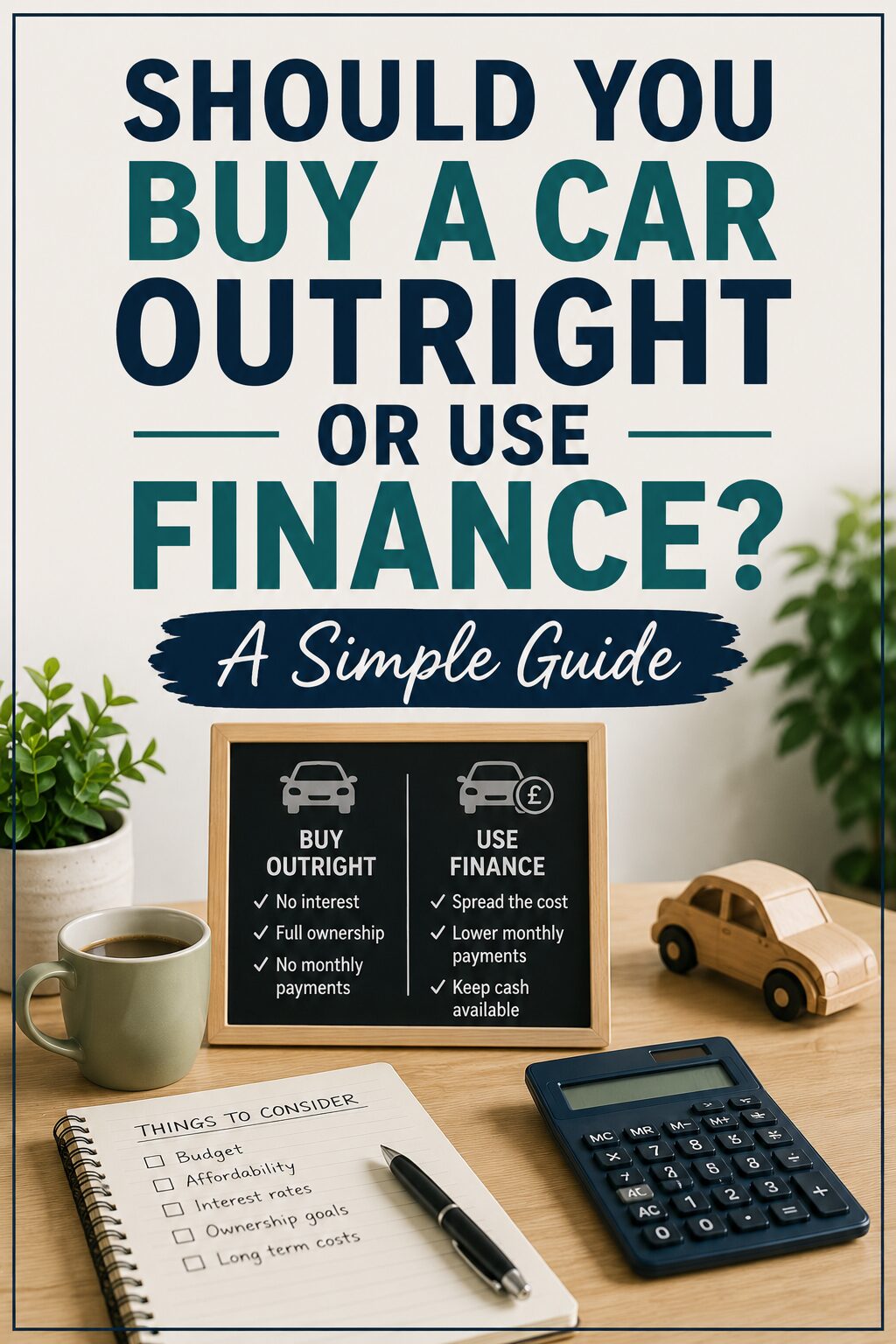
Should You Buy a Car Outright or Use Finance? A Simple Guide
Buying a car is no small thing. Cars are major financial responsibilities, and major stores of financial value too; they are not cheap commodities to be taken on at will. As such, getting yourself or your household a car is a serious undertaking that requires some serious decision-making. At the heart of this undertaking is a simple, key decision: whether to pay for a vehicle outright using savings, or to spread the cost by using a car financing agreement.
There is no one correct answer to this question, owing to the fact that every household has a different story financially. Picking the right option requires a deep understanding of personal factors such as budget, cash flow, long-term ownership plans and the total cost of borrowing. Here, though, we will explore these factors as they apply to you, as part of a simple guide into the world of buying a car.
Buying a Car Outright: The Benefits and Drawbacks

First, let’s look at buying a car outright – the most common way in which people obtain a car. Naturally, the upsides of buying up-front and outright are immediate ownership of the car in question, without ensuing payment commitments beyond those to be expected of running and maintaining a car. You are also locking in the purchase price of the car, avoiding any inflationary factors like interest.
However, buying a car outright requires you to have all that money upfront in the first place – otherwise you are simply passing the buck to a different form of credit line with potentially worse terms. Households are currently struggling overall, thanks to stagnated wages and a long-running cost of living crisis; tying up a significant amount of value in a car upfront can reduce stability going forward.
Understanding the Main Types of Car Finance

On the other hand, car financing agreements enable a household to obtain immediate access to a car without paying the full retail price up-front. One of a number of agreements can be made, chief amongst which are the Personal Contract Purchase (PCP) and Hire Purchase (HP) agreements.
PCP agreements involve a deposit and a set monthly cost, with the option to pay a lump sum for the vehicle at the end (or to switch to a new vehicle and start the process again). HP agreements are more straightforward, in that the payments lead to full ownership at the end of the contract. Either way, buying cars on finances enables households to access newer vehicles, since the higher cost of new vehicles can be spread over longer periods of time.
Comparing the Real Cost: Cash Purchase vs Finance
Car financing can make sense for households that need a car beyond their budget, such as new families in need of an MPV. However, for those with enough money to buy a car outright, finance agreements can be a more costly route to the same essential outcome. Ultimately, neither option is universally better. Buying outright may suit those with sufficient savings and a desire to avoid borrowing, while finance can provide flexibility and preserve cash reserves if the terms are competitive.
Pin It!