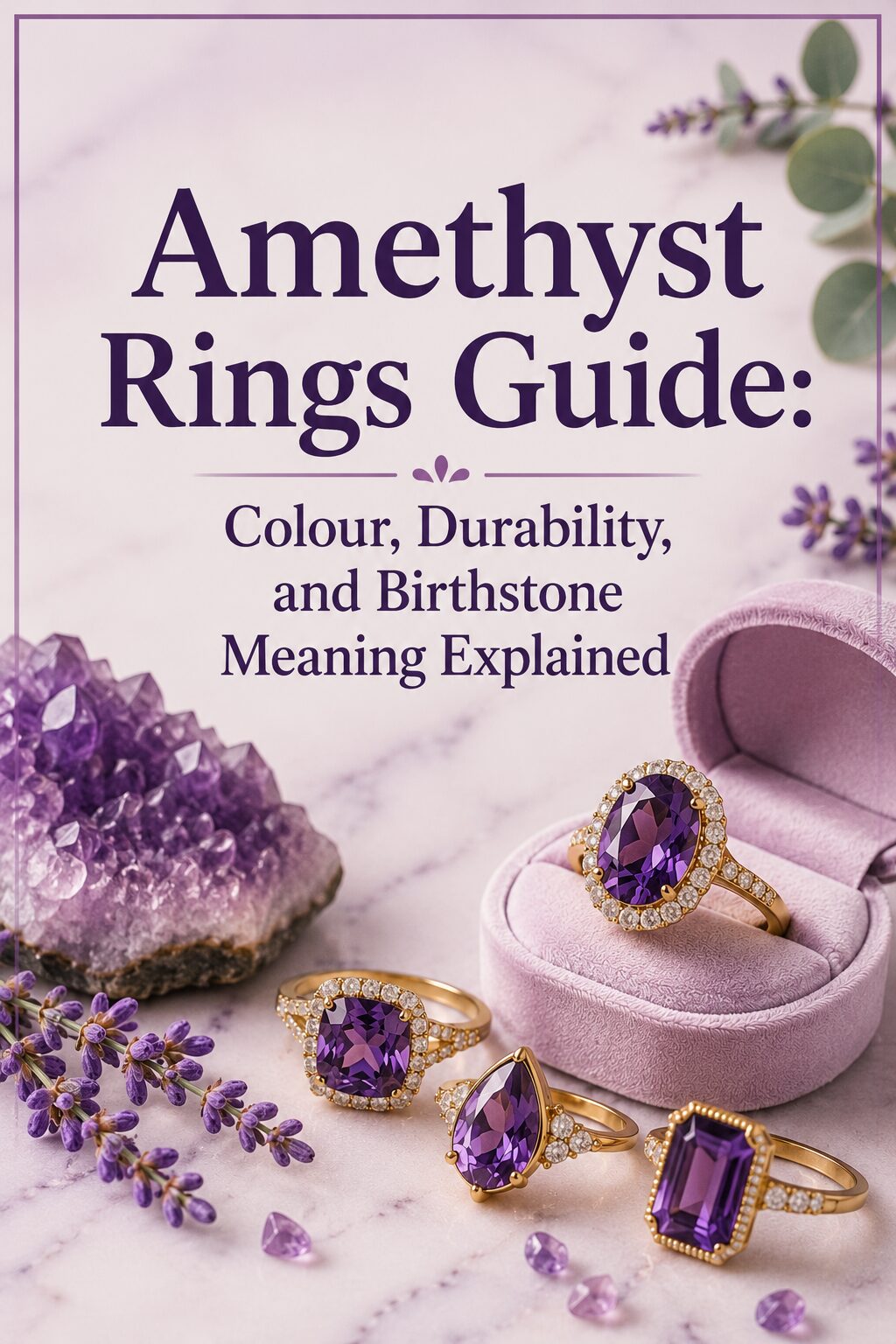
Amethyst Rings Guide: Colour, Durability, and Birthstone Meaning Explained
Amethyst is one of the most recognisable coloured gemstones, largely because its colour doesn’t need much explanation – the range from pale lilac to deep violet-purple is distinctive enough that most people can identify it without being told what it is. It’s also one of the more accessible colored gemstones for everyday jewellery, both in terms of hardness and general availability. This article looks at what actually causes amethyst’s colour, how it’s graded, how it holds up in daily wear, and how it fits into the broader tradition of birthstone jewellery.
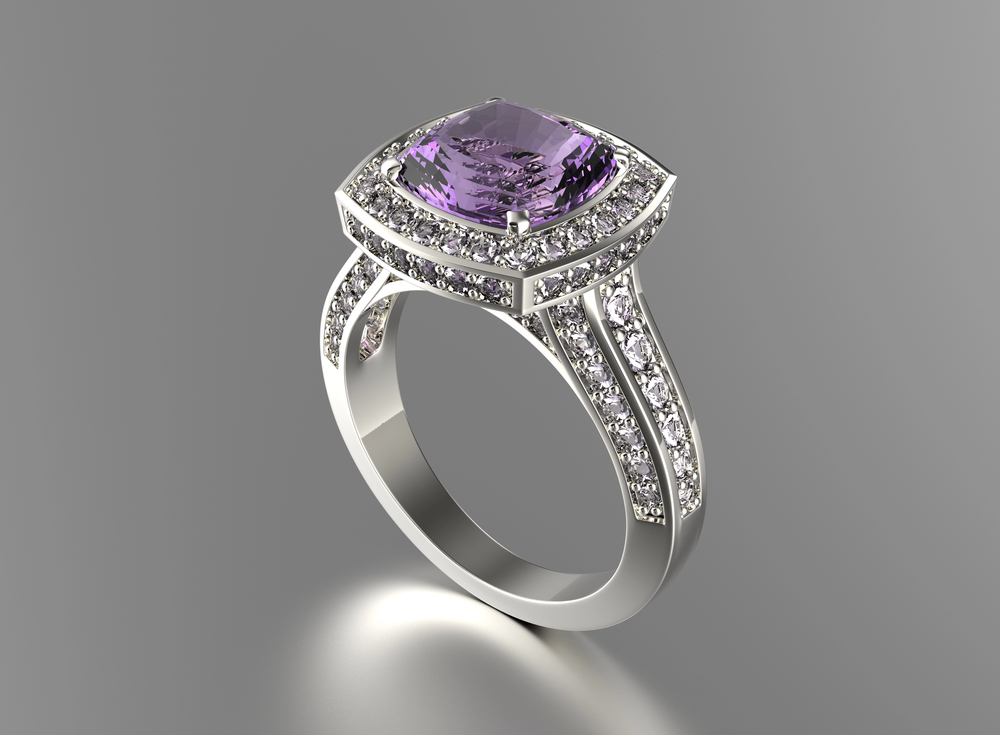
Beyond its striking appearance, an amethyst ring has remained popular for centuries because it combines attractive colour with practical durability. Whether chosen as a birthstone, a meaningful gift, or an everyday piece of jewellery, amethyst offers a balance of affordability and lasting beauty that few colored gemstones can match. Understanding how the stone forms, how its colour is evaluated, and how it performs in daily wear makes it much easier to choose a ring that will look its best for years to come.
What Amethyst Actually Is

The amethyst rings feature a gemstone that is a variety of quartz, chemically identical to clear quartz or citrine but with trace amounts of iron present in its crystal structure. On its own, that iron wouldn’t produce a purple colour. Instead, the shade develops through natural irradiation within the earth, which alters the iron impurities and produces the violet tone amethyst is known for. This is why amethyst deposits are often found in association with geological activity that exposed the forming crystal to background radiation over long periods.
Because it’s a quartz variety, amethyst shares quartz’s crystal structure and general durability, which is part of why it has remained a practical choice for rings specifically, unlike some softer colored stones that are better suited to earrings or pendants where they see less daily contact.
How Amethyst Colour Is Evaluated
Amethyst colour ranges from very pale lavender to a deep, almost black-purple, and the grading generally comes down to a few factors:
Hue and saturation – the most valued amethyst typically shows a deep purple with red or blue secondary flashes when tilted under light, rather than a flat, single-toned colour.
Colour zoning – because amethyst forms in layers, a single crystal can show visible bands of different colour intensity. Cutters often try to position the strongest colour under the table facet (the flat top of the stone) to maximise the appearance of even, saturated colour.
Clarity – amethyst is typically eye-clean at the commercial level, meaning inclusions aren’t usually visible without magnification, though heavily included stones do exist and are graded lower as a result.
Tone consistency under different lighting – some amethyst appears more reddish under incandescent light and more blue-violet under daylight or fluorescent light, a phenomenon that’s worth checking in person rather than relying solely on a single photograph.
Durability and Everyday Wear
Amethyst rates a 7 on the Mohs hardness scale, which places it comfortably above many other colored gemstones used in jewellery, such as opal or turquoise, though still softer than sapphire or diamond. In practical terms, this means amethyst resists everyday scratching reasonably well but can still be scratched by harder materials like sand (which contains quartz-hardness particles) or by contact with harder gemstones stored alongside it.
Amethyst is not typically treated with fracture-filling or other stability treatments the way some softer or more included stones are, though heat treatment is sometimes used to lighten overly dark material or to convert certain amethyst into citrine, since the same iron-based colour mechanism responds to heat in a different way than it does to natural irradiation.
Where Amethyst Is Typically Found
Amethyst deposits occur in a number of regions, each producing material with somewhat different characteristic colour:
- Brazil is one of the largest sources globally, often producing lighter to medium-toned material in large quantities.
- Uruguay is known for producing some of the deepest, most saturated violet-purple material, often prized for its intensity.
- Zambia has become a significant modern source, frequently producing rich purple stones with strong red flashes.
- The Ural Mountains in Russia historically produced material sometimes called “Siberian” amethyst, a term still occasionally used informally to describe deep purple material regardless of actual origin.
Common Cuts and Settings for Amethyst Rings

Because amethyst is transparent and takes a bright polish well, it’s commonly faceted in standard cuts such as round brilliant, oval, cushion, and emerald cut, each affecting how the colour zoning and saturation appear. Rounder, more brilliant cuts tend to break up colour zoning more effectively, while step cuts like the emerald cut show colour more openly, similar to how step cuts function with other transparent stones.
Amethyst’s moderate hardness means it can reasonably be set in most standard setting styles, including prong settings that expose more of the stone to light. That said, given its slightly softer profile compared to sapphire or diamond, more protective settings – such as a bezel or a prong design with additional metal coverage at the girdle – are often recommended for rings intended for frequent daily wear or manual activity.
Understanding the Birthstone System
The idea of associating specific gemstones with birth months has a long and somewhat inconsistent history. Some sources trace it to ancient associations between gemstones and the twelve tribes of Israel or zodiac signs, while the more standardised modern list used in most jewellery contexts today was formalised in the early 20th century by a national jewellers’ association in the United States, with later revisions adding alternate stones for certain months.
Because the list has been updated more than once, some months have more than one recognised birthstone – a “traditional” stone and a more recently added “modern” alternative. This is why birthstone jewellery collections are often organised with more than one gemstone option per month rather than a single fixed stone.
Where Amethyst and March Fit Into the Calendar
Amethyst is generally recognised as the birthstone associated with February, valued in that role for centuries due to its rich colour and historical associations with clarity and calm, dating back to ancient belief systems and its long use in ecclesiastical jewellery. While it is not the birthstone for March, understanding the distinction is helpful when comparing March birthstone jewelry, which typically features aquamarine or bloodstone instead of amethyst.
March, by comparison, is associated with two different stones depending on the list used: aquamarine, a pale blue-green variety of beryl, is the modern birthstone, while bloodstone, a dark green chalcedony flecked with red iron oxide spots, is the traditional birthstone for the same month. This is a useful example of how birthstone jewellery collections are typically structured – organised by month, but frequently offering more than one stone option to reflect both traditional and modern birthstone lists, rather than treating birthstone assignment as a single fixed rule.
Understanding this distinction matters when browsing any birthstone-organised jewellery collection, since a piece described as birthstone jewellery for a given month may be set with either the traditional or modern stone, and the two can look and behave quite differently in terms of colour, hardness, and care requirements.
Caring for Amethyst Jewellery
Amethyst can generally be cleaned with warm water, mild soap, and a soft brush, and it tolerates ultrasonic cleaners reasonably well compared to more fracture-prone stones, though it’s still worth checking a piece for existing internal cracks before using one. Prolonged exposure to strong, direct sunlight can gradually fade amethyst’s colour over long periods, so pieces intended for long-term display rather than wear are sometimes kept out of continuous direct light. As with most colored gemstones, storing amethyst separately from harder stones helps prevent surface scratching over time.
FAQs
Is amethyst durable enough for a ring worn every day?
Yes, generally. At a 7 on the Mohs hardness scale, amethyst holds up well under normal daily conditions, though it’s still softer than diamond or sapphire, so a protective setting is worth considering for rings that see frequent manual activity.
Why do some amethyst stones look more reddish and others more blue-violet?
This comes down to how the stone’s colour responds to different light sources. Some amethysts show a stronger red secondary tone under warm, incandescent lighting and a cooler blue-violet tone under daylight or fluorescent light, which is a natural characteristic rather than a flaw.
Is amethyst the birthstone for March or February?
Amethyst is traditionally associated with February. March is associated with aquamarine as the modern birthstone and bloodstone as the traditional birthstone – a distinct pair of stones rather than amethyst.
Why do some birthstone jewellery collections list two stones for a single month?
Many months have both a “traditional” birthstone, based on older historical lists, and a “modern” birthstone, added when a standardised list was formalised in the early 20th century. Collections often include both options rather than choosing just one.
Does heat treatment permanently change amethyst’s colour?
Yes, in most cases. Heat treatment used to lighten overly dark amethyst or convert it toward a citrine-like yellow tone is generally considered permanent and stable under normal wear conditions, unlike some treatments applied to other gemstone types that can be more temperature- or light-sensitive.
Pin It!